What is The Consent Machine™?
The Consent Machine™ is Boje’s name for the institutional configuration through which professional authority, AI platform power, cloud infrastructure, non-disclosure, economic-development agreements, and delegated narrative editing manufacture acceptance for an AI future. Its work is neither reducible to a single lie nor explained by individual bad faith. It is an organizational architecture that narrows the field of what counts as legitimate knowledge, prudent action, and inevitable progress before those affected can answer back.
The Machine joins a platform layer—models, data, compute, and ecosystems—to a consulting layer that sells strategy, governance, implementation, policy interfaces, and stakeholder alignment. Its public outputs may be responsible-AI frameworks, transformation narratives, participation processes, or claims of efficiency. Its concealed outputs can be platform dependency, ethics theater, depleted civic capacity, lost human potential, and costs that will arrive after the engagement has ended.
This is why the book works with the AI Storytelling Glossary: antenarrative, Ghost Vortex, Tamaraland, Tesseract Leadership, qualimetrics, and true storytelling are analytic instruments for keeping open the contested, plural, answerable story before an official Beginning–Middle–End narrative closes it.
Reading The Consent Machine™
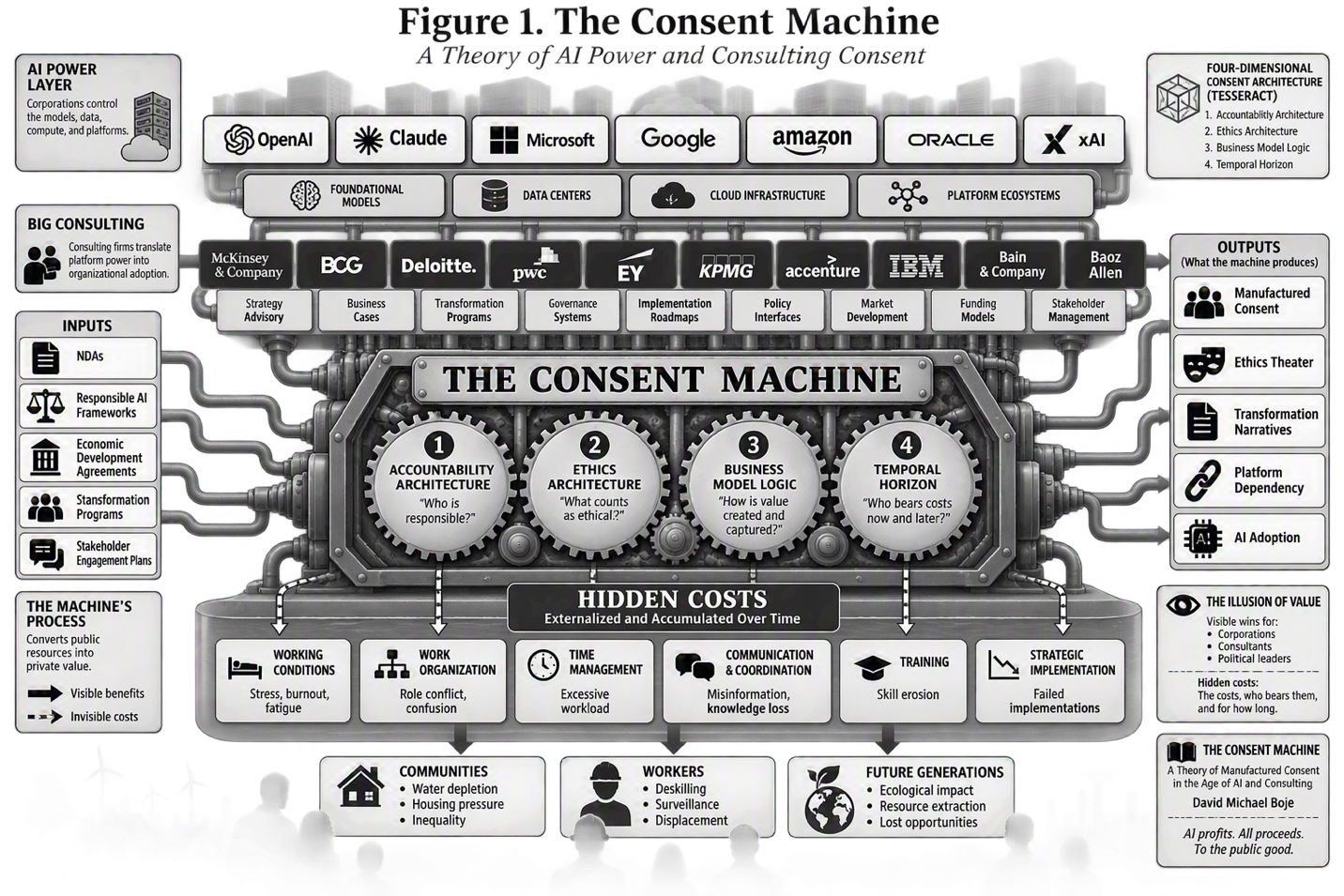
The Consent Machine™ connects the AI power layer, Big Consulting, institutional inputs, manufactured outputs, the four-dimensional tesseract, and the SEAM costs kept below the invoice.
Read the diagram from top to bottom. AI corporations command models, data, compute, clouds, and platform ecosystems. Consulting firms translate that power into strategy advice, business cases, governance systems, implementation roadmaps, policy interfaces, funding models, and stakeholder management. The inputs at the left—NDAs, responsible-AI frameworks, development agreements, transformation programs, and engagement plans—are then rendered as outcomes at the right: manufactured consent, ethics theater, transformation narratives, platform dependency, and AI adoption.
The four gears name the tesseract vector:
𝕋 = (A, E, B, τ)
A = accountability architecture; E = ethics architecture;
B = business-model logic; τ = temporal horizon.
Any claim that an AI transformation has “created value” is incomplete unless it can be read across all four coordinates. A technically functional system can fail on accountability; an ethical policy can fail when its business model captures the benefit and externalizes harm; a present gain can be an intergenerational loss. The tesseract is therefore a simultaneous, not sequential, form of reasoning.
The Gap. Let V be visible contracted value and H be costs omitted from the public or organizational story. Then accountable value cannot be reported as V alone: Vaccountable = Vvisible − Hexternalized
SEAM gives the Gap a qualimetric ledger. In the book, hidden costs are traced across work conditions, work organization, time management, communication and coordination, training, and strategic implementation. In a working SEAM estimate, hidden cost may be modeled as H = h(WC, WO, TM, CC, TR, SI); the notation does not pretend every cost is already known. It prevents the visible invoice from being mistaken for the whole economic reality. The book’s 167% benchmark is a diagnostic working estimate in a particular SEAM tradition, not a universal constant.
Boje’s antenarrative (Boje, 2001, 2011) is the methodological counter-move: retrieve the story fragments, testimony, suppressed alternatives, and future bets before the Machine hardens them into a single official account. The Ghost Vortex names the structural spinning of ethical language away from ethical practice. Tamaraland reopens the multiple rooms in which different actors experience the same AI decision differently. Together, they make the mathematics of the page answerable to lived consequence.
Research apparatus: the companion field site
The Storying.site companion holds an accessible 500-word entry point, visual genealogy, narrative-stability diagram, and working tables. It extends this page; it does not replace the complete book or the master AI Storytelling Glossary.
Illustrative SEAM hidden-cost ledger
This is a teaching and diagnostic composite, not a claim that every engagement carries the same amount. It makes visible what a consulting invoice normally leaves outside the story.
| Hidden-cost category | Illustrative amount |
|---|
| AI rework | $420,000 |
| Shadow-AI breach (per incident average) | $4.74 million |
| Abandoned pilots | $680,000 |
| Fee overruns | $840,000 |
| Non-creation of potential | $520,000 |
| Total concealed exposure | $2.46–$7.2 million |
|---|
Read the sources, methods, and full Big Ten platform/capture ledger at Storying.site →
Three conversations now opening
Hillon identifies the human result of a successful Consent Machine: cognitive surrender. A person accepts an AI-produced answer or organizational story without retaining the difficult labor of testing evidence, questioning the frame, and judging its consequences. His developing Series 3 Volume 5 treats strategy storytelling as a counter-practice: the return of inquiry, ethical judgment, dialogue, and the capacity to read what a smooth story has excluded.
Isenor’s longitudinal human–AI archive brings the Consent Machine down to the interaction between one human storyteller and an AI system. Its continuity failures, reconstruction work, correction cycles, and insistence on voice show why fluency is not co-creation. The human must remain the continuity layer and the morally answerable editor, or delegated narrative editing becomes an erasure of the storyteller.
The planned Stage 1 Registered Report gives this book a preregistered empirical companion. Its 2 × 2 design crosses narrative fidelity with editorial control, alongside a human-only benchmark. It tests ownership, agency, authorship continuity, and moral answerability: when does AI assistance augment a person’s story, and when does low fidelity plus low human control produce cognitive surrender? The password-protected E‑Ticket contains the current author-review proposal, Trafimow methodology, Living Story design, appendices, and the October 15 submission work.
 CLICK HERE TO GO TO THE SERIES 3 SIX VOLUMES OF BUSINESS STORYTELLING IN THE AI REVOLUTION
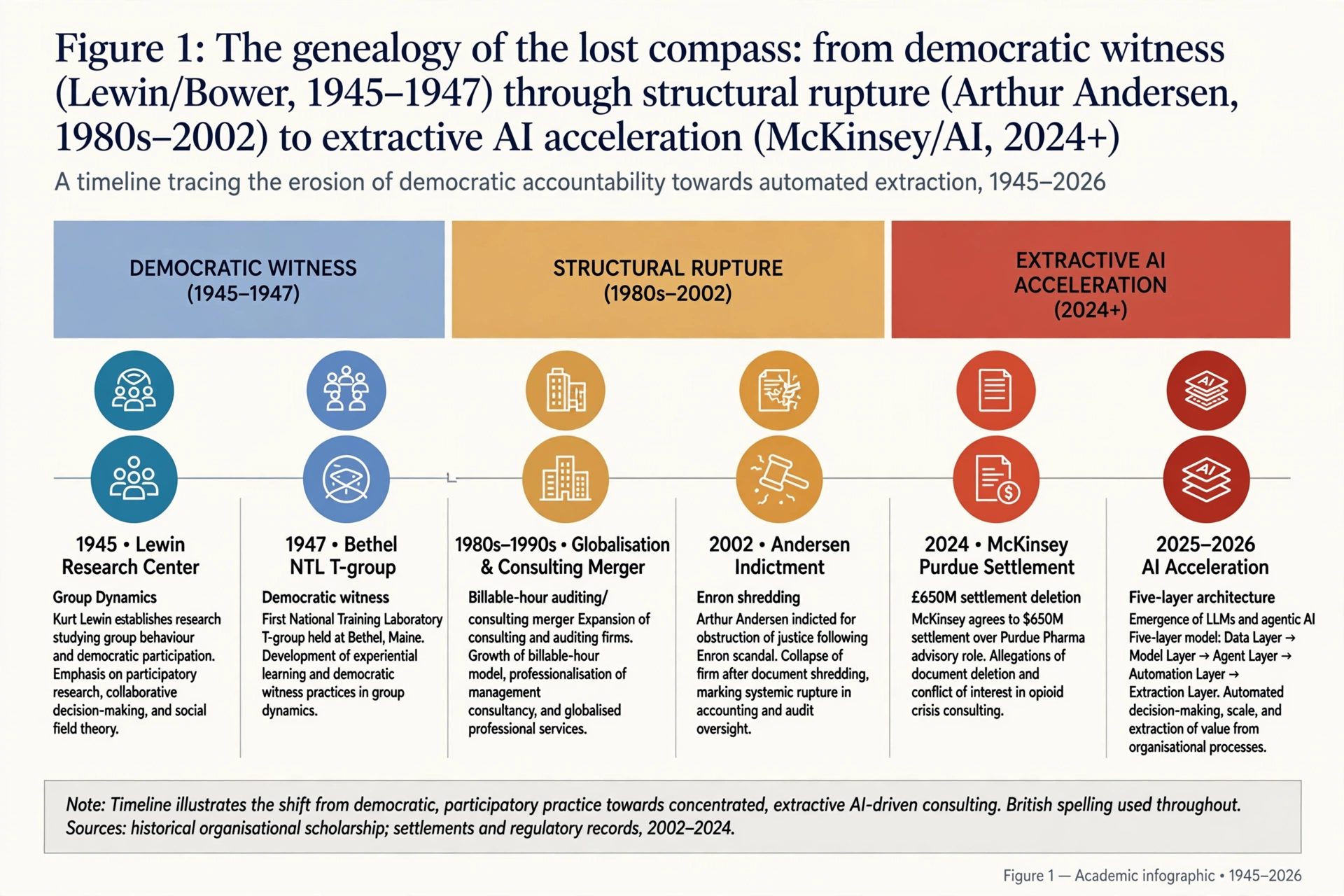 Genealogy: the lost compass →
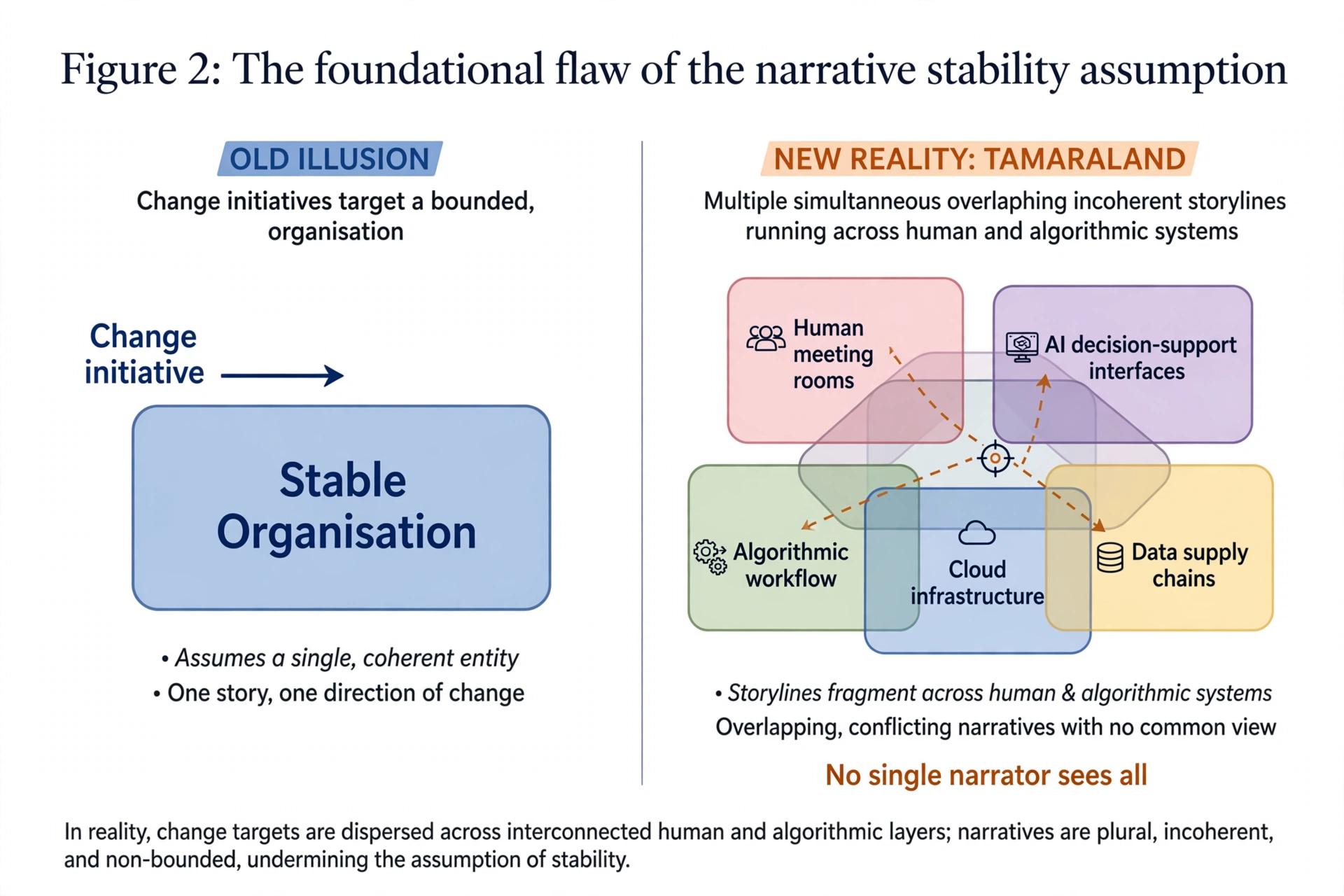 Narrative stability and Tamaraland →