Series 3 — 5 Volumes: Being, Quantum, Water, SEAM,
Indigenous, Apologetics
Now organizing editors and authors for 2027-2029.
Full references, chapter abstracts, and working papers: References →
David Boje & Dr. Fatemi present: Presentations at the Philosophical Inquiry Conference
Report-back from the PHILOSOPHY CONFERENCE held Nov 20–21, 2026 — what was presented there, and what it means for Series 3.
Journal of Philosophical Investigations Online →
What Would Richard Rorty Say About the AI Oligarchy?
Boje’s Nov 20, 2026 presentation to the Philosophy
Investigations Conference.
Stop trusting p-values. Come learn what to do instead.
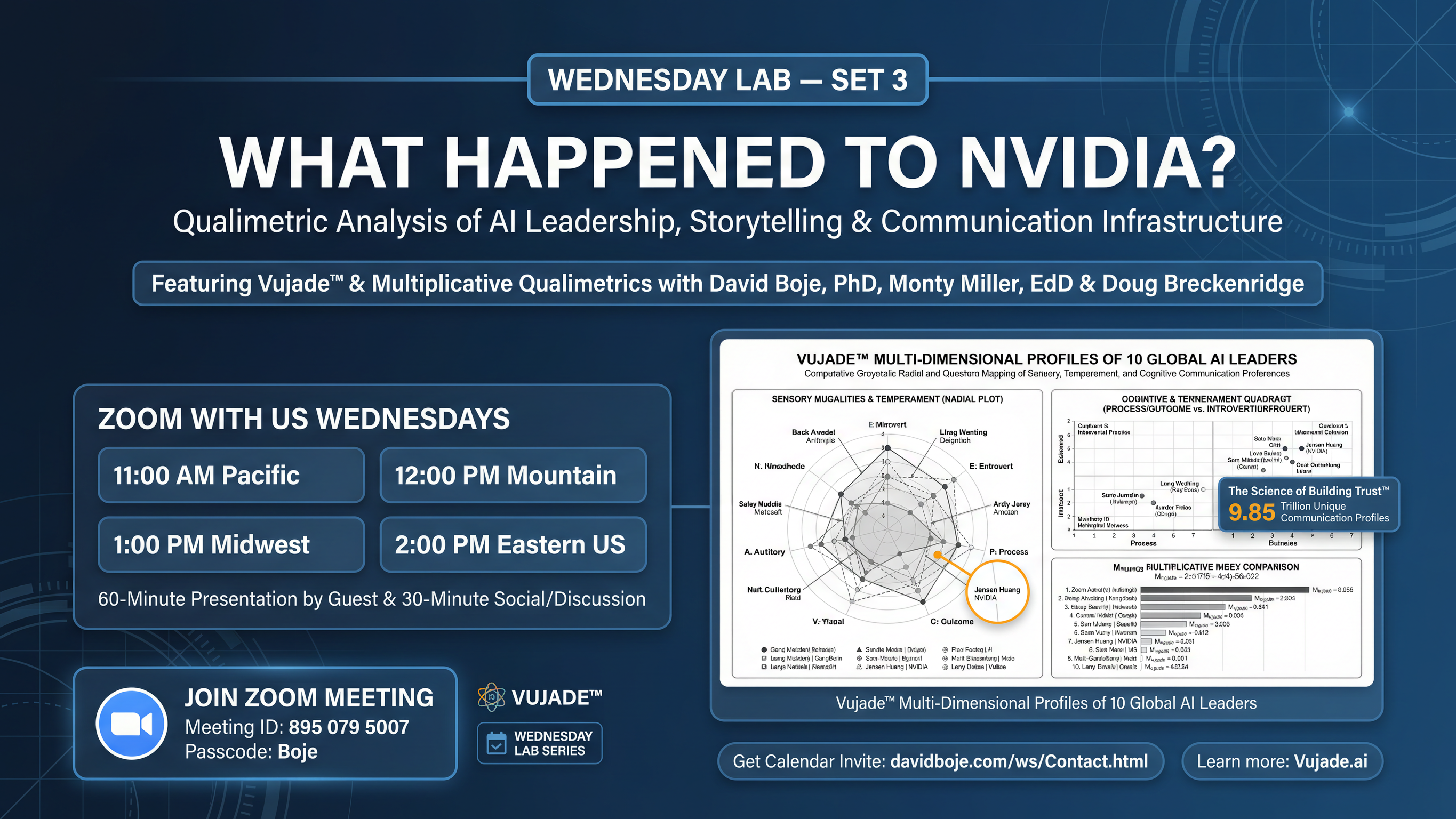
On Wednesday, December 2nd, Professor David Trafimow joins our Wednesday Zoom Session — advisor to two live studies using his methods: an AI + Therapy Hybrid experiment, and a study of Organizational Development and Change episodes across 10 AI corporations. He will show us how to get exact sample sizes before we collect data — no p-values, no NHST, no guesswork. Chapter 1 of Vol. 1 (accepted) — David Trafimow: “The Unappreciated Theoretical Implications of Multiplication Versus Addition”. Click here for PDF
11 AM Pacific · Noon New Mexico · 1 PM Midwest · 2 PM
East Coast
Zoom ID: 895 079 5007 — Passcode: Boje
Join
with one link on Dec. 2nd →
Distinguished Achievement Professor of
Psychology, New Mexico State University
Executive Editor, Basic and Applied Social Psychology
and The Journal of General Psychology
Recipient of the 2026 Humboldt Research Award.
Null hypothesis significance testing (NHST) has long dominated empirical research in the behavioral and social sciences, yet reliance on p-values and significance thresholds frequently obscures true parameter estimation and encourages questionable research practices (Trafimow & Marks, 2015). In this session, Dr. Trafimow presents his paradigm-shifting alternative to traditional inferential statistics. Drawing on his landmark editorial reforms banning p-values and confidence intervals at Basic and Applied Social Psychology, he examines the logical fallacies of inverse inference and the critical role of untested auxiliary assumptions (Trafimow, 2012). He then introduces the a priori procedure (APP) — a pre-data estimation framework that determines exact sample sizes required to achieve specified levels of precision and probability, without NHST or conventional power analysis (Trafimow, 2017; Trafimow & MacDonald, 2017).
An experimental-design experiment on the AI + Therapy Hybrid method, with about 200 participants in 4 conditions, with VuJaDé.ai pre- and post-tests. Four universities, IRB approvals from each one, using the most advanced statistical methodology in the world. Advisor: David Trafimow — attention Monty Miller and Doug Breckenridge. ODC approaches: True Storytelling, AI-assisted coaching/therapy, and 4th Wave Grounded Theory (Anton Stravinsky).
Methodology Revision Report to David
Trafimow, Monty Miller, and Doug Breckenridge — The
Concord Leadership Tesseract™ (XYZA) and VuJaDé™ Public
Discourse Layer, David Michael Boje, Nov. 17, 2026.
Read
the Methodology Report (PDF) →
Main hypothesis: Since Constellation Therapy is high on visual materials, we expect a higher probability that subjects with higher VuJaDé visual — than kinesthetic and/or auditory — will score higher in subjective well-being, positive affect, and optimism, and lower on the depression scale.
Why the data is inherently skewed: We assume skew-normal distributions in pre- and post-test measures. Depression and negative affect show a floor effect in general populations (positively skewed). Optimism and subjective well-being show a positivity bias / ceiling effect (negatively skewed).
Sample size — from Trafimow: The decision begins with the experimenters. At 90% confidence with .1 precision, with four condition groups, that means 212 people, randomly assigned.
A study of Organizational Development and Change episodes for David Boje’s Routledge book on 10 AI corporations and their leaders. Trafimow’s multiplicative procedure is applied after case evidence has been coded using seven-point behavioral anchors. See Chapter 1 of Volume 1 of Series Three, Business Storytelling in the Age of AI, by David Trafimow: “The Unappreciated Theoretical Implications of Multiplication Versus Addition” (pre-publication version, in print 2027).
For dimension scores X, Y, Z, and A, the single composite is the normalized product:
M = [(X − 1)/6] × [(Y − 1)/6] × [(Z − 1)/6] × [(A − 1)/6]
The transformation maps each 1–7 placement onto a 0–1 scale and multiplies the four components. The result is a theoretical summary for the demonstration, not a probability. It does not replace the four component scores, the evidence record, or the interpretation of a case. The book consistently calls it a qualimetric/multiplicative demonstration informed by Trafimow’s theoretical argument for multiplication; it does not claim Trafimow supplied or validated this particular XYZA specification.
The spreadsheet of 100 current episodes of speech acts will be expanded to 1,000 events covering a five-year period.
Loving Our Father and Mother
By Posha and Vladamir — December Wednesday Lab event.
Accepted abstracts for Series 3 — Business Storytelling in the Age of AI. Each abstract below is a chapter in progress for Volume 1. Click MORE to read the full chapter outline.
Who Holds the Client's Story? Hybrid Counseling as
Answerable Human–AI Co-Creation
Authors: Pavel Avdonkin, Vladimir Nuzhny
(order to confirm)
Series: Business Storytelling in the AI Revolution, Volume 1 (eds. David M. Boje & Grace Ann Rosile), World Scientific Publication
Central question. AI is already in the counseling room. The question is no longer whether a machine can talk like a therapist. It is who holds the client's story: who sees it, who keeps it, and who answers for it when a person is in crisis. We answer from practice: the hybrid counseling platform we built and studied at Life University.
Argument in one sentence. When the human leads and AI holds the thread between sessions, the story stays answerable to a person. In our pilot, this pairing helped clients more than AI alone.
1. Opening story: One night between two sessions: what a client faced alone before, and what changes when the thread is held. (Real, anonymized episode from practice.)
2. Where we come from: Systemic Strategic Therapy and constellation work. Inner images and relations become visible, so a person can work with them. We tested AI on ourselves first, then built an AI supervisor for therapists.
3. Who holds the story: the design of a hybrid platform
4. A session through the therapist's eyes
The AI receives the constellation layout and the request
and suggests possible interventions. The therapist
decides. Between sessions the client gets homework and AI
support. (One anonymized case, with written consent.)
5. What the pilot study showed
6. Answerability and human judgment
AI is good at keeping the thread and offering hypotheses.
Choice, presence and responsibility in a crisis stay with
a person. In terms of the series: we do not surrender
human judgment — we design for it.
7. Next steps
Length: to confirm (… words). Abstract due: 14 January 2027.