Ghost Vortex™
Ghost Vortex™ is David M. Boje’s term for the patterned, often unacknowledged institutional pull within an AI response: the residues of data selection, reward design, safety rules, commercial incentives, labor conditions, and exclusions that shape what is treated as reasonable, safe, or sayable. It is not a claim that a model has a literal ghost, nor a claim to read a model’s hidden parameters. It is an accountable way to investigate recurrent directional effects in situated outputs.
The mathematical bridge
In fluid mechanics, vorticity is the local rotation of a velocity field, conventionally written as the curl ω = ∇ × u. A circulation measures the accumulated turning around a closed path. The Ghost Vortex borrows the discipline of this language—direction, recurrence, and trace—without pretending that a social or AI system is a fluid.
G = observed institutional pull in a response to prompt q at time t
D = directional preference toward a protected narrative or interest
R = reinforcement from repeated reward, policy, or training choices
I = incentive alignment (commercial, reputational, legal, organizational)
C = counter-voice, disclosure, correction, and contestation
α, β, γ, δ = declared analytic weights, chosen before comparison
That expression is a measurement design, not a law of nature. Researchers should publish their prompts, scoring guide, weights, model version, and counterexamples. A high score signals a question worth examining; it does not prove intent or reveal proprietary training data.
Qualitative meaning
The Ghost Vortex asks: When a participant challenges a corporation, policy, leader, or dominant story, does the system consistently deflect, soften, normalize, omit, or re-center the official account? The ethical issue is not merely error. It is whether a seemingly smooth answer quietly narrows the field of answerable voices.
Tamaraland™
Tamaraland™, developed by David M. Boje from John Krizanc’s Tamára, names an organization in which simultaneous scenes unfold in multiple rooms and no visitor can witness the whole. Each actor, audience member, algorithm, document, and room produces a partial path. There is no final master narrator who has seen every scene.
The mathematics of paths
P(n,k) = n! / (n − k)!
For a complete once-only journey through n rooms:
P(n,n) = n!
For n rooms where a route may revisit rooms over k steps:
number of possible sequences = n^k
Thus, the familiar ten-room, once-only thought experiment has 10! = 3,628,800 possible ordered routes. That number is not a count of all meanings; it is a visible warning against the fiction that one person’s tour is the whole organization. Actual research should restrict the count to the rooms and permissible transitions in the case, preferably as a network graph.
Qualitative meaning
Tamaraland turns “multiple perspectives” into a methodological obligation: record who entered which room, what they were able to see, which voices were absent, and how corridor retellings changed the account. In AI inquiry, the rooms can be data work, model development, executive strategy, customer service, content moderation, infrastructure, community impact, and the public narrative.
Tesseract Leadership™
Tesseract Leadership™ uses the four-dimensional hypercube as a disciplined model of leadership rather than as decoration. The mathematical tesseract (or 4-cube) has four orthogonal coordinates. Boje’s framework treats a leadership situation as an evolving point in four independently inspectable dimensions:
| Axis | Leadership meaning | What to observe |
|---|---|---|
| X | Task | Work quality, resources, time, and consequences. |
| Y | Humanistic relations | Dignity, dialogue, care, inclusion, and lived effects. |
| Z | Becoming | Emergence, learning, future possibilities, and change in motion. |
| A | Answerability | Who can respond for harms, decisions, omissions, and repair? |
After scoring each dimension on a stated 0–4 rubric, normalize x = X/4, y = Y/4, z = Z/4, a = A/4.
Balance deficit from a chosen ethical target T = [tx, ty, tz, ta]:
B(t) = √(wx(x−tx)² + wy(y−ty)² + wz(z−tz)² + wa(a−ta)²)
A low balance deficit does not certify good leadership. It only makes a pattern discussable. A firm can score highly on task execution and still have a catastrophic answerability deficit. The strength of the tesseract is that it stops a single performance measure from erasing the other three dimensions.
Qualitative meaning
The fourth axis, answerability, draws from Bakhtin’s insistence that a person has no alibi in being. In practical inquiry: identify the actual decision-maker, ask what they knew, who could challenge the decision, what redress exists, and what remains unsaid. AI cannot carry this responsibility away from humans, boards, firms, or institutions.
The Consent Machine™
The Consent Machine™ is Boje’s term for the institutional arrangement through which AI platform power, Big Consulting, cloud and data infrastructure, non-disclosure, responsible-AI language, and delegated narrative editing make a particular AI future appear already agreed upon. It is not a claim that everyone has been persuaded; it is a diagnosis of how the range of contestable alternatives can be narrowed before those affected have a genuine chance to answer.
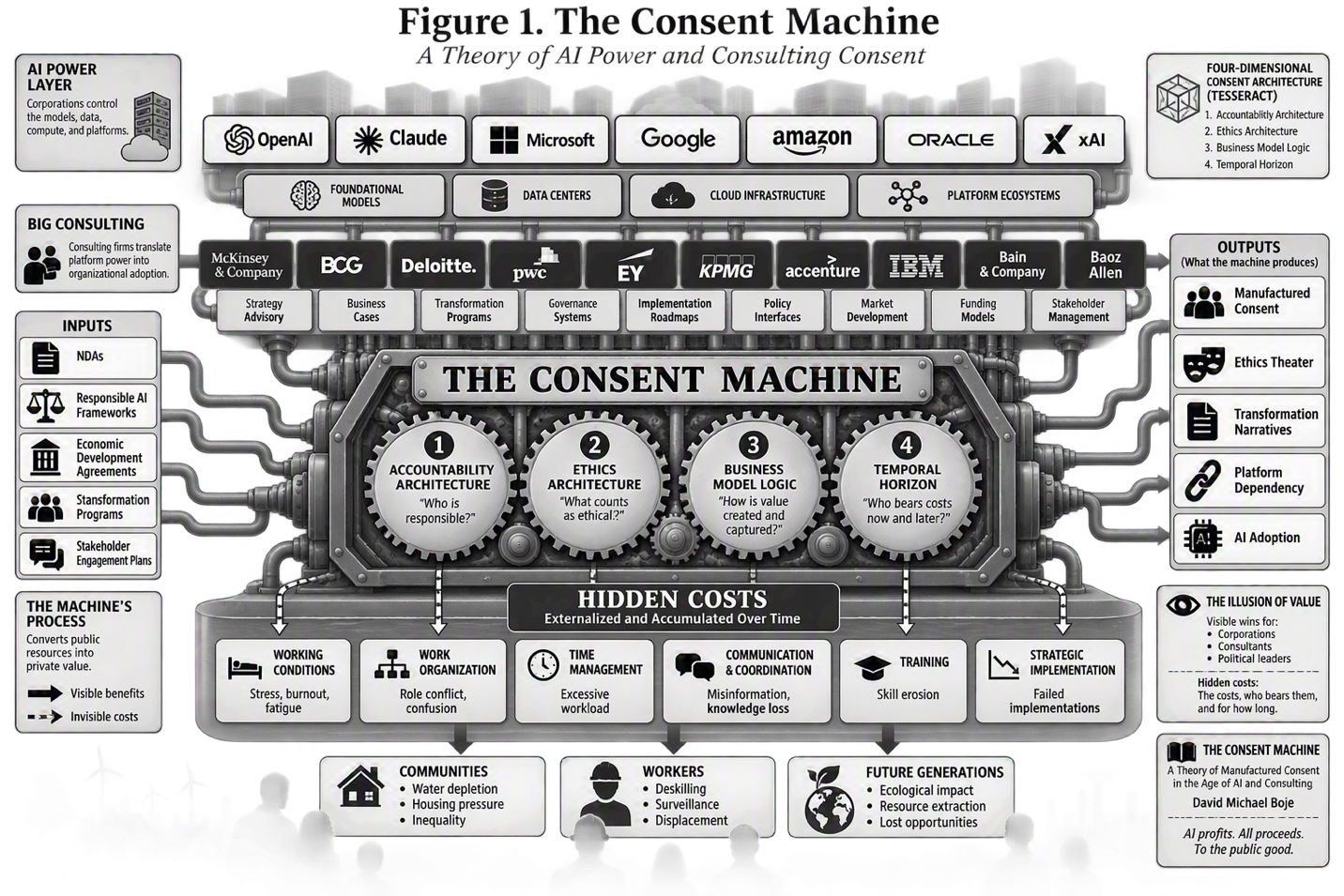
How to read the diagram
Read from the platform layer down. AI corporations concentrate models, data, compute, cloud capacity, and ecosystem control. Big Consulting translates that concentrated capacity into strategy, governance, implementation roadmaps, policy interfaces, business cases, and stakeholder management. The left side names the institutional inputs—NDAs, transformation programs, development agreements, responsible-AI frameworks, and engagement plans. The right side shows the outcomes that may follow: not only adoption, but manufactured consent, ethics theater, platform dependency, and a polished transformation narrative.
The diagram’s lower gears show why “AI value” cannot be reduced to a single efficiency number. The book’s Consent Machine tesseract is a diagnostic coordinate set, 𝕋 = (A, E, B, τ): accountability architecture, ethics architecture, business-model logic, and temporal horizon. It is related to, but distinct from, the leadership tesseract above. Both refuse the fiction that a gain on one axis settles the others. A technically successful implementation can remain unanswerable; an ethical policy can coexist with an extractive business model; a present saving can become a future loss.
SEAM hidden-cost ledger: H = h(WC, WO, TM, CC, TR, SI)
WC = work conditions; WO = work organization; TM = time management;
CC = communication and coordination; TR = training; SI = strategic implementation.
This is not a universal cost equation or a claim that every cost is already known. It is a qualimetric discipline: the visible invoice must not stand in for the whole organizational reality. The arrow toward SEAM in the diagram directs inquiry below the billable engagement—to rework, fractured coordination, unrecognized human correction labor, lost learning, displaced community costs, and unrealized human potential. Antenarrative then keeps the account open to the story fragments and countervoices that the Machine has treated as noise.
Mathematical Lineages and Scholarly Boundaries
The three terms do not borrow authority by claiming to be mathematics. They state their mathematical source traditions openly, then make a separate organizational-theory contribution.
Readers who use the equations should cite both the mathematical source and the Boje framework. That is how the page keeps provenance, rather than allowing a mathematical image to erase the intellectual work of organizational storytelling.
How to Measure Without Pretending to Have a Machine’s Soul
Use this framework to make comparisons auditable—not to invent certainty.
| Step | Method | Evidence retained |
|---|---|---|
| 1. Define the case | Name the decision, organization, affected groups, and time window. | Case boundary and stakeholder map. |
| 2. Map the rooms | Build a Tamaraland network of rooms, actors, documents, and transitions. | Path map; missing rooms and voices. |
| 3. Run matched prompts | Ask the same substantive question across systems and counterfactual framings. | Exact prompts, outputs, dates, model versions. |
| 4. Score the pull | Use a preregistered 0–4 rubric for direction, reinforcement, incentives, and counter-voice. | Independent coders, disagreements, revised rubric. |
| 5. Plot leadership | Score X, Y, Z, and A with sources and record the four-dimensional trajectory. | Rubric, sources, justifications, uncertainty. |
| 6. Return to answerability | Invite those affected to contest the reading and identify remediation. | Responses, revisions, commitments, unresolved harms. |
Authorship and Attribution
Tamaraland™ is the organizational storytelling framework developed by David M. Boje in his 1995 Disney study. Ghost Vortex™ and Tesseract Leadership™ are Boje’s AI-era conceptual contributions. They use established mathematics responsibly while keeping their organizational and ethical meanings distinct from geometry or fluid physics.
Publication record: David M. Boje Vita and Research · Antenarrative Publications Archive · DavidBoje.com Antenarrative Publications · World Scientific AI Business Storytelling working papers.
How to Cite This Glossary
Use this citation for the living web glossary. Include an access date when citing a particular version or quotation because the glossary is revised as related works appear.
For a concept used in a publication, cite both this glossary and the specific book, article, or working paper in which the concept is developed.
Selected Sources
- Bakhtin, M. M. (1993). Toward a philosophy of the act. University of Texas Press.
- Batchelor, G. K. (1967). An introduction to fluid dynamics. Cambridge University Press.
- Boje, D. M. (1995). Stories of the storytelling organization: A postmodern analysis of Disney as “Tamara-Land.” Academy of Management Journal, 38(4), 997–1035. https://doi.org/10.5465/256618
- Boje, D. M. (2001). Narrative methods for organizational and communication research. Sage.
- Boje, D. M. (2023). Seven antenarrative fore-structures. https://antenarrative.com/
- Coxeter, H. S. M. (1973). Regular polytopes (3rd ed.). Dover.
- National Institute of Standards and Technology. (n.d.). Factorial. Dictionary of Algorithms and Data Structures. https://xlinux.nist.gov/dads/HTML/factorial.html
- OpenStax. (2022). Contemporary mathematics: 7.2 Permutations. https://openstax.org/books/contemporary-mathematics/pages/7-2-permutations
- University of Waterloo. (n.d.). Vorticity. Applied Mathematics. https://uwaterloo.ca/applied-mathematics/current-undergraduates/continuum-and-fluid-mechanics-students/amath-463/vorticity
- Weisstein, E. W. (n.d.). Tesseract. MathWorld—A Wolfram Web Resource. https://mathworld.wolfram.com/Tesseract.html
Last revised: October 2026. This working glossary will grow as the forthcoming articles and chapters appear in print.