This Wednesday Lab prepares the research proposal and pilot
study for the October 15 submission, then opens a 15-minute Richard
Rorty dialogue with Professor Muhammad Asghari. The editorial circle
and breakout rooms connect this work to the six volumes.
October 14 Writers Lab agenda
Formal 60-minute session
Followed by an optional 30-minute conversation for volume
editors, authors, and scholar-practitioners.
0–5 minDavid M. Boje — welcome,
orientation, the research proposal, and the pilot study.
5–15 minDavid M. Boje, Nazanin, Rosanna, Ronnie Saylors, and colleagues — ten-minute research-proposal and pilot-study presentation.
15–30 minProfessor Muhammad Asghari
— Richard Rorty: philosophy, truth, self-creation, and the
questions AI-assisted storytelling raises.
30–40 minOpen discussion — the Rorty dialogue, the research proposal, and questions from participants.
50–60 minBreakout Storytelling
Circles — ten minutes for presenters, Professor Asghari, research-proposal questions, volume and authorship ideas; each participant has an equal speaking opportunity.
CloseReturn and close — one
shared takeaway and next Wednesday’s invitation.
Optional follow-on, 30 minutes: volume editors and
authors may continue the discussion and plan later Wednesday
sessions.
Permanent home · Volume Editors & Contributing Authors
Three connected conversations for the six volumes
This is the continuing home for these contributions, not a weekly agenda notice. It gives editors, contributors, and readers one stable place to see how the work connects to the six-volume Business Storytelling in the Age of AI project and to the RECORD Registered Report.
David Michael Boje · Edward Elgar book draft
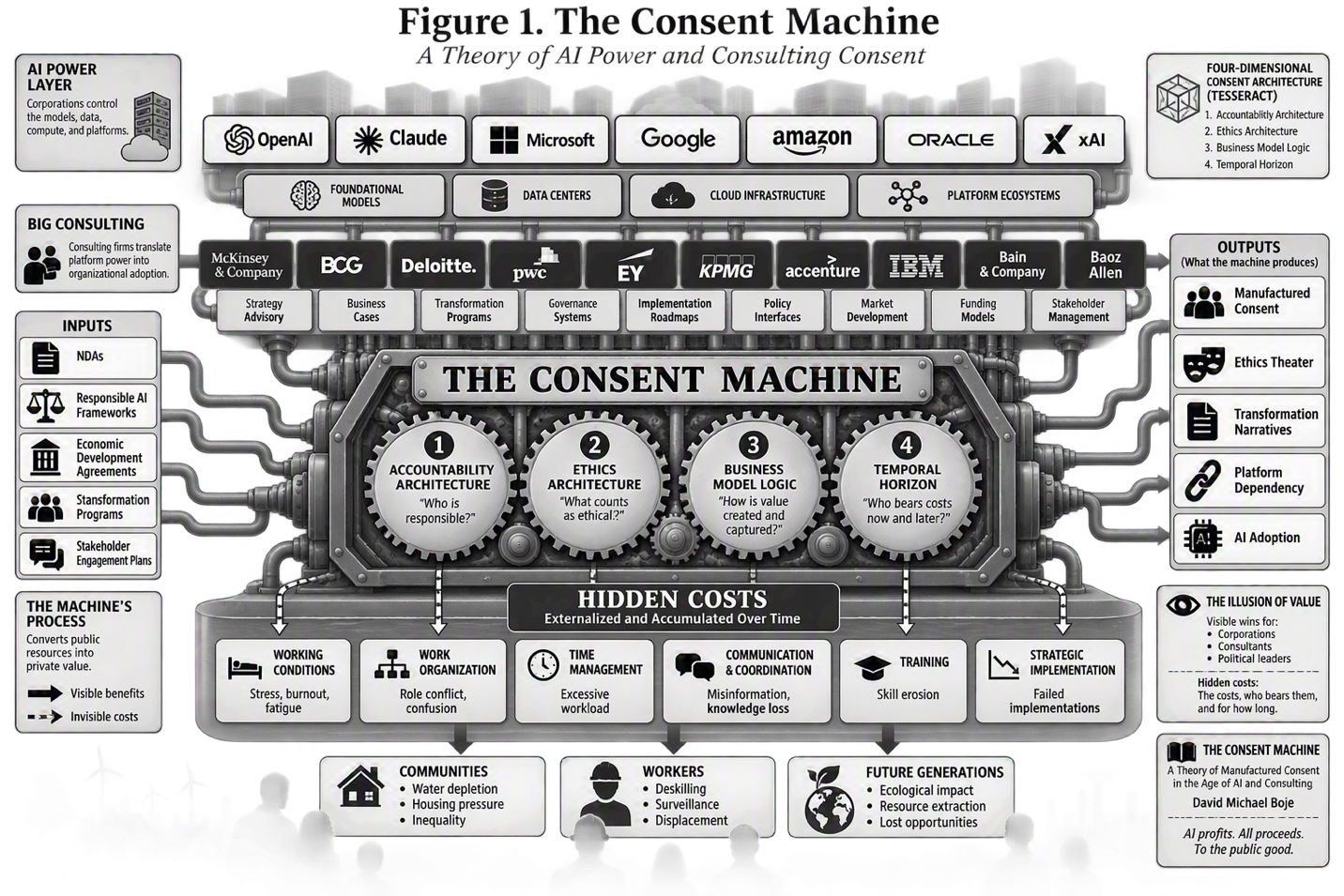
The Consent Machine™
The Consent Machine™ names the institutional configuration through which platform power, Big Consulting, non-disclosure, responsible-AI language, and delegated narrative editing make a particular AI future appear already agreed upon. Its counter-practice is antenarrative: recover the unfinished stories, human potential, hidden costs, and answerability that a smooth transformation narrative leaves outside the frame.
Hillon names the human consequence of a successful Consent Machine: accepting an AI-generated answer or organizational story without retaining the labor of testing evidence, questioning its frame, or judging its effects. Strategy storytelling restores inquiry, dialogue, ethical judgment, and the capacity to read what a smooth story has excluded.
Illa Isenor · Longitudinal human–AI archive
Continuity, Repair, and Human Voice
Isenor carries the narrative, visual instructions, corrections, repetition, and intended meaning between otherwise separate AI systems. Her longitudinal archive makes that human continuity work visible—and shows why the final AI-generated artifact cannot be treated as though it made itself.
PerplexityDarker interpretation of the shared concept.GPTTransferred context, directed revision, and a changed visual language.
The human continuity bridge: the similarities show what Illa’s continuing direction achieved; the differences show the platform-specific interpretation and the otherwise hidden human labor of repair, memory, and editorial control.
How the three conversations meet RECORD and the six volumes
RECORD Registered Report: the planned 2 × 2 study of narrative fidelity and editorial control tests ownership, agency, authorship continuity, and moral answerability. The Consent Machine supplies the institutional diagnosis; Hillon identifies cognitive surrender; Isenor supplies the lived problem of continuity and repair.
Volume 2 · Algorithmic Sensemaking & Delegated Narrative Editing: asks how organizational meaning is edited, authorized, and displaced through AI.
Volume 3 · True Storytelling & Inclusion: gives human voice, plural testimony, and answerable participation their central place.
Volume 4 · Human–AI Co‑Creation: studies the conditions under which assistance becomes genuine co-creation rather than replacement or erasure.
Volume 5 · SEAM: makes visible the hidden costs and lost human potential beneath AI transformation claims.
Volumes 1 and 6: extend the question to organizational futures and to water, AI, and the life of all species—where consent, accountability, and consequence cannot be separated.
Professor Asghari will open a short preparation dialogue on
Richard Rorty: pragmatism, self-creation, moral answerability,
and what these questions offer AI-assisted storytelling.
October 14 · Clickable readings and editor resources
Open the working papers and six-volume roster
Each reading opens in a full browser tab rather than inside the small agenda frame.
 StoryLand Writers Lab