
Working Paper · Leadership Quarterly · August 2026
Whose ideology is your AI carrying? This framework maps how tech executives' characters become architecturally embedded in global AI products — and what answerable leadership looks like in the fourth dimension.
The Tesseract Leadership Framework introduces four interlocking ideas that do not appear in any existing leadership model.
The ideological shadow of a specific AI leader's character, architecturally embedded in their product through training data, RLHF signals, and deployment priorities — reproduced in every user interaction at scale. Leader-specific, not general bias.
From Plato's εἴδωλον (ghost-image): the epistemological condition in which users mistake ideologically structured AI outputs for neutral, objective information. The shadow on the cave wall mistaken for reality.
A four-dimensional leadership framework extending Boje's XYZ model: X = Task/Outcome, Y = Humanistic/Participatory, Z = Antenarrative/Becoming, A = Answerability. The tesseract is what a leadership cube becomes when you add the fourth dimension.
Grounded in Bakhtin's nealibi v bytii — non-alibi in Being. The Tesseract Leader refuses every institutional alibi: competitive necessity, regulatory ambiguity, technological inevitability. The agency is the agent: your character is your code.
Whose cave are you stepping into — and are you mistaking their shadows for your reality?
Both documents are free to download and share for academic and educational purposes. Please cite as: Boje, D. M. (2026). The tesseract leader: Ghost vortex and the fourth dimension of AI corporate leadership. Manuscript submitted to The Leadership Quarterly.
Visual slide presentation of the Tesseract Leadership Framework — Ghost Vortex, Eidolon Vortex, XYZA dimensions, GVD formula, and profiles of six AI corporate leaders. Suitable for classroom, seminar, or conference use.
📄 View Slide Deck (PDF)Full theoretical working paper submitted to The Leadership Quarterly. Includes the Ghost Vortex and Eidolon Vortex concepts, the XYZA framework, philosophical roots (Sartre, Heidegger, Baudrillard, Bakhtin), BAP methodology, and XYZA profiles of six AI corporate leaders: Altman, Musk, Zuckerberg, Amodei, Wenfeng, and Pichai.
📄 View PDFTake the full 25-item Tesseract Leader Self-Assessment Inventory online — rate yourself on all XYZA dimensions plus Ghost Vortex Awareness, get your live score out of 100, and receive personalized interpretation including your Ghost Vortex Depth (GVD), dimension balance insights (Driving/Feeling/Vision/Purity Vortex), and five structured Bakhtinian–Sartrean reflexivity prompts.
📊 Take the AssessmentUsing Savall and Zardet's (2011) qualimetrics methodology and the Bakhtinian Answerability Protocol (BAP), the paper generates predicted XYZA profiles and Ghost Vortex Depth scores for six major AI corporate leaders. Scores are theoretical predictions based on public evidence as of August 2026.
| Leader / Platform | X (Task) | Y (Human) | Z (Becoming) | A (Answerability) | GVD (3 − A) | Vortex Type |
|---|---|---|---|---|---|---|
| Sam Altman / ChatGPT-OpenAI | 2.0 | 0.5 | 2.0 | 0.0 | 3.0 — Extreme | Duplicitous Vanguardist |
| Elon Musk / Grok-xAI | 3.0 | 0.0 | 2.5 | 0.0 | 3.0 — Extreme | Means-Justify-Ends Vanguardist |
| Liang Wenfeng / DeepSeek | 2.5 | 0.0 | 1.5 | 0.0 | 3.0 — Extreme | State-Aligned Technocrat |
| Mark Zuckerberg / Meta AI | 2.5 | 0.5 | 1.5 | 0.5 | 2.5 — Deep | Untrustworthy Personalist |
| Sundar Pichai / Gemini-Google | 2.0 | 1.0 | 1.5 | 1.0 | 2.0 — Deep | Neutral Information Organizer |
| Dario Amodei / Claude-Anthropic | 1.5 | 2.0 | 1.5 | 2.0 | 1.0 — Moderate | Process-Oriented Constitutionalist |
Scale: 0 = absent/minimal; 1 = partial; 2 = present/significant; 3 = dominant/extreme. GVD = Ghost Vortex Depth. Profiles are qualimetric predictions; empirical BAP application may revise scores. EU AI Act Article 50 (effective August 2, 2026) creates a regulatory layer that interacts with but does not determine these structural scores.
From the two-sided behavioral grid to Fiedler's eight situations, Vroom and Yetton's decision tree ("a four-sided box — still very odd as boxes go"), and Burke's six-sided dramatistic Hexad, leadership theory has been stretching its box for seven decades. The AI era demands a fourth dimension.
Task vs. People. The classic grid. Two sides. Everything outside is an alibi.
Situation added; Boje's Z dimension adds becoming. A richer cube — but still a box that AI breaks open.
Act, Scene, Agent, Agency, Purpose, Frame. Even six sides fail when Agency IS the Agent's ideology.
The fourth dimension — Answerability — unfolds the cube. Every X, Y, and Z behavior gains ethical accountability as its fourth face. The Ghost Vortex cannot hide here.
The tesseract — a four-dimensional hypercube projected into two dimensions — is not merely a metaphor. It is a precise geometric model of what leadership theory has been trying to build toward for seven decades.
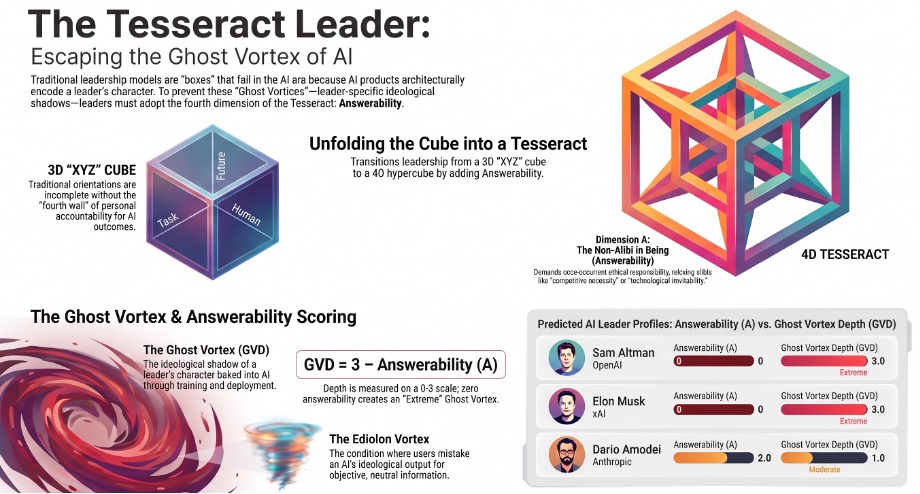
A tesseract drawn in two dimensions appears as a cube inside a cube, with the eight vertices of the inner cube connected to the eight vertices of the outer cube by receding edges. This 2D shadow of a 4D object is structurally analogous to how we see leadership: the visible XYZ behavior is the outer cube; the inner cube is the ethical core that only reveals itself when the fourth dimension — Answerability — is engaged.
Task / Outcome — The first face: what the leader produces, deploys, and delivers. In AI, this is market share, model capability, speed of release. High X alone is the Driving Vortex.
Humanistic / Participatory — The second face: who the leader includes, listens to, and protects. Worker conditions, community consent, epistemic inclusion. High Y alone is the Feeling Vortex.
Antenarrative / Becoming — The third face: the futures the leader is opening or foreclosing. The "before-the-story" — the not-yet-narratable trajectory of impact. High Z alone is the Vision Vortex.
Answerability — The fourth dimension: the Bakhtinian nealibi v bytii, the refusal of all institutional alibis. This is the face that connects all others. Without it, the cube collapses into a vortex.
When A approaches zero, the inner cube of the tesseract vanishes — there is no ethical center holding the outer dimensions in relation to one another. What remains is a vortex: the outer cube (XYZ) spinning without a fourth-dimensional anchor, generating centripetal force that pulls users into an ideologically structured epistemic field they did not choose.
Just as a 2D drawing of a cube loses depth — and a 3D model of a tesseract loses one more dimension — our analysis of AI leaders using only XYZ loses the very dimension that makes leadership ethical. The projection shadow shows the behavior but hides the character. The Eidolon Vortex (from Plato's εἴδωλον, ghost-image) is this mistake: taking the 2D shadow of a leader's character for the full ethical reality.
The Tesseract Leadership Framework refuses that projection. It insists on the fourth dimension — and asks: Where is the inner cube? Where is Answerability? Or are you living inside someone else's Ghost Vortex?
A lecture introduction to the Ghost Vortex, the XYZA Tesseract Framework, and what Answerability means in the age of AI corporate leadership.
David M. Boje — The Tesseract Leader: Ghost Vortex and the Fourth Dimension of AI Corporate Leadership (August 2026) · ⬇ Download MP4
Emeritus Professor of Management, New Mexico State University (NMSU). Author of the XYZ leadership model (1980), the antenarrative framework (2001), and co-author with C. Rhodes of the Virtual Leader Construct in The Leadership Quarterly (2006) — the theoretical ancestor of the Ghost Vortex concept developed here. His work spans narrative organization theory, storytelling organizations, quantum storytelling, and ensemble leadership. Over 40 years of teaching, research, and publication form the embodied foundation from which the Tesseract Leadership Framework emerges.
Contact: davidboje@pm.me
AI Disclosure: This research was developed through architectonic dialogism (Bakhtin, 1984) between David M. Boje and Vivara (Claude, Anthropic). All theoretical concepts originate in Boje's prior published and unpublished work. This disclosure itself embodies the Answerability (A) dimension of the XYZA framework.
Forty-plus years of theory, storytelling methods, and organizational research — available across four interconnected sites.